


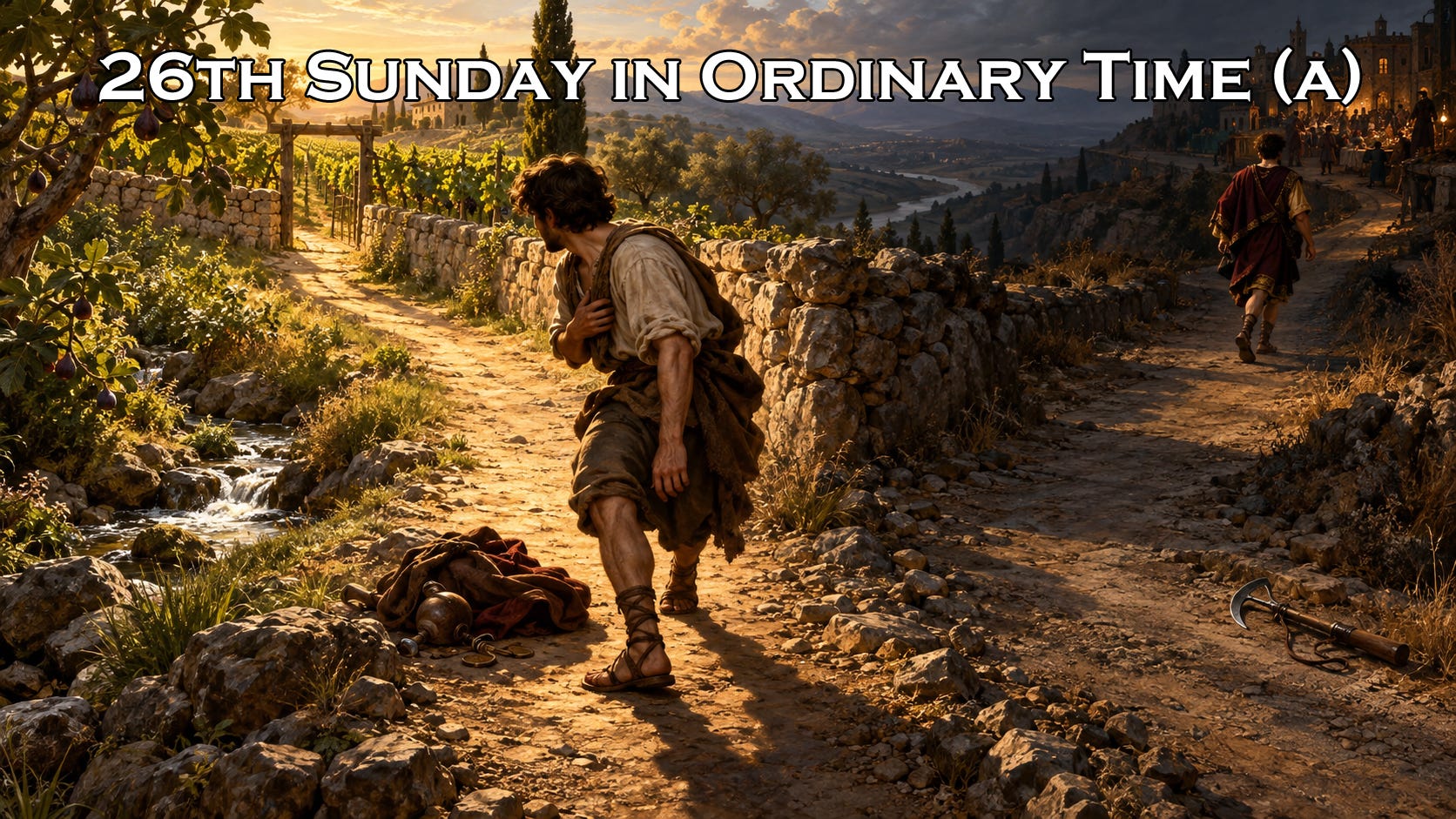
We can’t un-sin our sins. But a bad history isn’t the last word.
In the Gospel for Novus Ordo on the 26th Ordinary Sunday (Year A - Matthew 21:28–32) Our Lord describes in a brief parable a father who asks his two sons to work in his vineyard. One refuses, then thinks better of it, and goes to work. The other gives an initial obedient answer but goes AWOL. Jesus asks the attending chief priests and elders which son did the father’s will. They answer correctly: the first. Then the Lord brings the question home to them. Tax collectors and prostitutes believed John the Baptist and turned toward God. The leaders saw this happen, yet would not change their minds and believe. Their initial answer to Jesus is sound but their concrete response to God’s call was wanting.
The parable obviously puts great weight on results. The first son’s refusal was real. What he at first said to his faith could not be unsaid. But he could, however, get up and go into the vineyard. The second son’s “yes” was also real as a spoken answer. It, however, bears no fruit because he didn’t follow up with obedience.
By this parable, Jesus gives hope to anyone ashamed of an earlier refusal concerning faith and morals. It also offers a probing question to anyone comfortable with a lifetime of seeming religious propriety.
What am I doing with the Father’s request today?
In the Old Testament reading for Sunday the Prophet Ezekiel (18:25–28) addresses the frightful notion that our past has fixed our future. The people have whined that the Lord’s way is unfair. God replies through Ezekiel that a person who turns away from wrongdoing and acts justly will live. Implicit in the Prophet’s admonition is that conversion is possible, a sinner can truly change his ways. He also underscores the freedom we have. A righteous person is free to choose to turn away from God just as a sinner can choose to make amends. A bad history isn’t the last word. The first son in the parable gives Ezekiel’s teaching a face: he changed his mind, and then changed his course.
Psalm 25, the Responsorial Psalm (which I would rather be replaced with the singing of the Gradual, which can be done in the Novus Ordo) gives us the attitude words for a change of course for the better. We ask the Lord that He might show us His ways, He might teach us His paths, and that He remember His mercy rather than the sins of our youth. More than the mere instruction that we have to do better, we need to learn, to be guided where to walk. We need the mercy of the One who guides us. The psalm says that God guides the humble in justice. Humility allowed the first son to reconsider his initial refusal. It allowed the tax collectors and prostitutes, whom Christ mentions to the chief priests and elders, to hear the call of John the Baptist. The chief priests and elders saw their response, Jesus says, “and even when you saw it, you did not afterward repent and believe him” (v. 32).
At the beginning of Mass the priest prays for you:
Deus, qui omnipotentiam tuam parcendo maxime et miserando manifestas, gratiam tuam super nos indesinenter infunde, ut, ad tua promissa currentes, caelestium bonorum facias esse consortes.
Quite Literally:
O God, who manifest Your omnipotence especially by sparing and by being merciful, pour Your grace upon us unceasingly, so that You may make us, rushing to the things You have promised, to be coheirs of heavenly benefits.
The Collect names the power at work when a sinner turns. God’s mercy opens the way back. His grace guides the journey. The image of us currentes, “running”, is striking when juxtaposed the Gospel parable. At first neither son ran to the vineyard. The first son finally goes where his father sent him. We ask in the Collect for the grace to go with greater readiness, rushing toward all that God has promised.
Paul shows us the deepest pattern of obedience. He urges the Philippians (2:1-11) to have the same mind of Christ, to put aside rivalry and vain glory, and “in humility count others better than yourselves” (v.3). He writes of the Son who humbled Himself and became obedient even to death on a cross. The Greek for “humility” here is ταπεινοφροσύνη - tapeinophrosýnē - “having a humble opinion of one’s self”. This is rendered in Latin as humilitas, “humility or lowliness”. It derives from the adjective humilis, “low” or “humble.” This is further derived from humus, meaning “earth” or “ground,” reflecting the concept of being grounded or low down to the earth.
Remember O man that thou art dust....
The two sons in the parable expose the distance between words and deeds. Christ closed that distance perfectly: His love for the Father is enacted in the costly gift of Himself. His obedience also makes our authentic conversion possible. We can answer the Father anew because the Son has gone before us to the Resurrection through the Cross.
A practical take away from this Gospel pericope could be that we should keep from assigning permanent places to the people around us. How often do we see in, for example, mass media coverage of politics or just about anything else that picks on a person’s past fault and therefore brands him with it forever as not even the most zealous Donatist could accomplish. Yet Jesus speaks of tax collectors and prostitutes entering the “the treasures of Heaven” ahead of those who considered themselves its guardians. Their sins mattered, they really happened. They could not be “unsinned”. Neither are they forgotten. But their repentance is real too, really real since they are closer to the real ones they were meant to be. We cannot read a soul by its public standing only. We can, however, examine our own response when God calls us to work.
Perhaps we have said “yes” often. Today’s question is whether that “yes” has become an act. Is there some sin to confess, a neglected duty to perform, a person to forgive? Perhaps we have said “no” and are tempted to think “Oh well, too late”. The first son tells us that we may still rise and go to the vineyard. It requires a first step. Then another and another.
Ask the Lord to strengthen your knees to stand and the direction for your feet. This is a fitting response to the mercy for which Holy Church prays:
CURRENT ICEL (2011):
O God, who manifest your almighty power above all by pardoning and showing mercy, bestow, we pray, your grace abundantly upon us and make those hastening to attain your promises heirs to the treasures of heaven.
I am so grateful that my parish schola sings the gradual and all antiphons. Great texts this week! one of my favorite undergrad papers was on the pericope from Philippians 2.
we mix it up a bit. Entrance antiphon, just the ladies. Gradual, just the men in the sanctuary led by the pastor. Offertory and Communion the ladies sing the antiphon and we all do falsobordone/fauxbordon for the rest. i'm eagerly looking forward to this Sunday and resuming schola after a two-week absence due to heart surgery and associated maladies.
I am 63 and obviously grew up in the ever changing Novus Ordo. I distinctly remember the reply in our paperback missal in the pew as …’and also with thee’! Anyone else?